The conventional view of aging is one of inevitable decline, a slow fade marked by lower energy, lost strength, and growing limitations. We’re taught to accept that getting older means getting weaker, slower, and more fragile.
But what if that narrative is incomplete?
What if aging isn’t simply something that happens to us, but something we can meaningfully influence through how we train, eat, recover, and care for our bodies?
At Ignite Performance & Health, we view aging as an active process. While time itself is unavoidable, how we experience aging is highly variable. The goal isn’t just to live longer, but to live better, to extend healthspan, not just lifespan. That means preserving strength, maintaining energy, and continuing to engage fully in life, regardless of chronological age.
This isn’t wishful thinking. It’s grounded in physiology. By integrating three core pillars, medical insight, strength training, and nutrition, we help create a framework for aging defined by resilience and capability rather than decline. This article outlines the Ignite approach to aging well and how these pillars work together to support long-term vitality.
Pillar 1: Medical Insight, Looking Under the Hood
Aging doesn’t start with wrinkles or gray hair. It begins at the cellular and metabolic level. Understanding what’s happening internally provides critical context for making smarter decisions about training, recovery, and nutrition.
Rather than relying on guesswork or generic advice, a proactive, data-informed medical approach helps guide a more individualized strategy.
Biomarkers and Hormonal Assessment
As we age, natural shifts occur in hormone levels, stress response, and metabolic efficiency. Hormones such as testosterone, DHEA, and growth hormone may trend downward over time, while stress hormones like cortisol may remain elevated in chronically stressed individuals. These changes can influence energy, body composition, recovery, and overall well-being.
The Ignite approach begins with comprehensive blood analysis to better understand these patterns. Rather than focusing solely on whether values fall within broad population reference ranges, we evaluate how different markers relate to symptoms, lifestyle, and performance goals, always within a clinician-guided framework.
- Hormonal Signaling: Identifying patterns that may be associated with fatigue, reduced recovery capacity, or changes in body composition helps inform next steps and lifestyle priorities.
- Inflammatory Markers: Chronic low-grade inflammation has been widely associated in research with accelerated aging processes. Tracking markers such as C-reactive protein (CRP) helps guide nutritional, training, and recovery strategies.
- Metabolic Health: Assessing blood sugar regulation, insulin response, and lipid profiles provides insight into how efficiently the body is using and storing energy.
This information doesn’t replace action, it informs it. The goal is clarity, not labels.
Pillar 2: Strength Training: Building the Body for the Long Game
If there is one intervention consistently associated with healthy aging, it is resistance training. Muscle plays a central role in metabolic health, mobility, and long-term independence.
Addressing Age-Related Muscle Loss
Age-related muscle loss, often referred to as sarcopenia, is not an inevitable consequence of aging, it is strongly associated with inactivity. Research shows that inactive adults can lose meaningful amounts of muscle mass over time, while those who strength train regularly retain significantly more function.
Maintaining and building muscle:
- Supports metabolic rate by preserving metabolically active tissue
- Improves glucose handling by increasing the body’s capacity to store and utilize carbohydrates
- Supports bone strength through mechanical loading that promotes skeletal resilience
Functional Strength and Independence
The real value of strength training isn’t aesthetic, it’s practical. Strength enables you to move confidently, recover more quickly, and remain independent. Carrying groceries, getting up off the floor, traveling, and playing with grandchildren all require physical capacity.
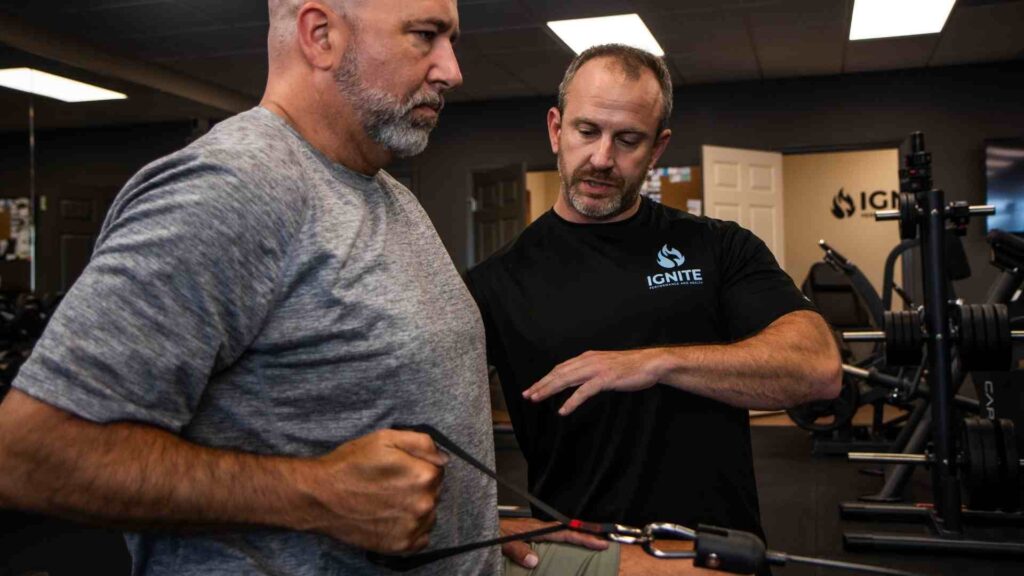
At Ignite, we emphasize intelligent, individualized resistance training built around compound movements that support real-world strength while respecting joint health and recovery.
Pillar 3: Nutrition: Fueling Longevity
Training creates the stimulus for change. Nutrition provides the raw materials to adapt.
Protein as a Priority
As we age, the body becomes less responsive to dietary protein, a phenomenon known as anabolic resistance. This means higher-quality and adequately distributed protein intake becomes increasingly important for maintaining muscle mass.
Our nutrition strategies typically emphasize sufficient daily protein intake, often in the range of approximately 1.2–1.6 grams per kilogram of body weight, tailored to the individual and spread across meals to support muscle protein synthesis.
A Nutrient-Dense, Inflammation-Aware Approach
Beyond protein, we focus on whole, minimally processed foods that support recovery and metabolic health:
- Healthy fats such as omega-3s from fish and plant sources
- Colorful vegetables to provide micronutrients and antioxidants
- Strategic carbohydrates aligned with activity levels to support energy and training performance
Nutrition at Ignite isn’t about restriction. It’s about fueling the work required to stay strong.
The Power of Integration: The Ignite System in Practice
The real impact comes from integrating all three pillars into a cohesive system.
Medical insight provides context.
Strength training provides the stimulus.
Nutrition provides the resources to adapt.
For example, a client may arrive feeling fatigued and noticing strength loss. Their lab work may reveal patterns consistent with increased inflammation and suboptimal hormonal signaling. This information helps guide a training program focused on progressive resistance and a nutrition plan emphasizing adequate protein and recovery-supportive foods.
Over time, improvements in strength, body composition, and subjective energy often coincide with favorable shifts in follow-up markers. Progress in one area reinforces progress in the others, creating a positive feedback loop.
Conclusion: Age with Intention
Aging is inevitable. Decline is not automatic.
The outdated narrative that growing older means becoming weaker and less capable does not reflect what modern physiology, and real-world experience, shows us. With the right inputs, the body remains adaptable far longer than most people realize.
The Ignite approach replaces guesswork with data, passivity with action, and fear with informed confidence. By integrating medical insight, intelligent strength training, and intentional nutrition, aging becomes something you actively participate in, not something that happens to you.
Your body is designed to be resilient.
Your later years can be strong, capable, and deeply fulfilling.
It’s time to stop simply aging and start aging well.
This article is for educational purposes only and is not intended to diagnose or treat medical conditions.